Goodreads

After trawling through the mire of paid promotions which are on offer to self-published authors, it struck me that some of the best of them are free. Goodreads springs to mind, although not everything is truly free (like the Goodreads Giveaway offer), most of the forums and connections available to you with readers  are free of charge.

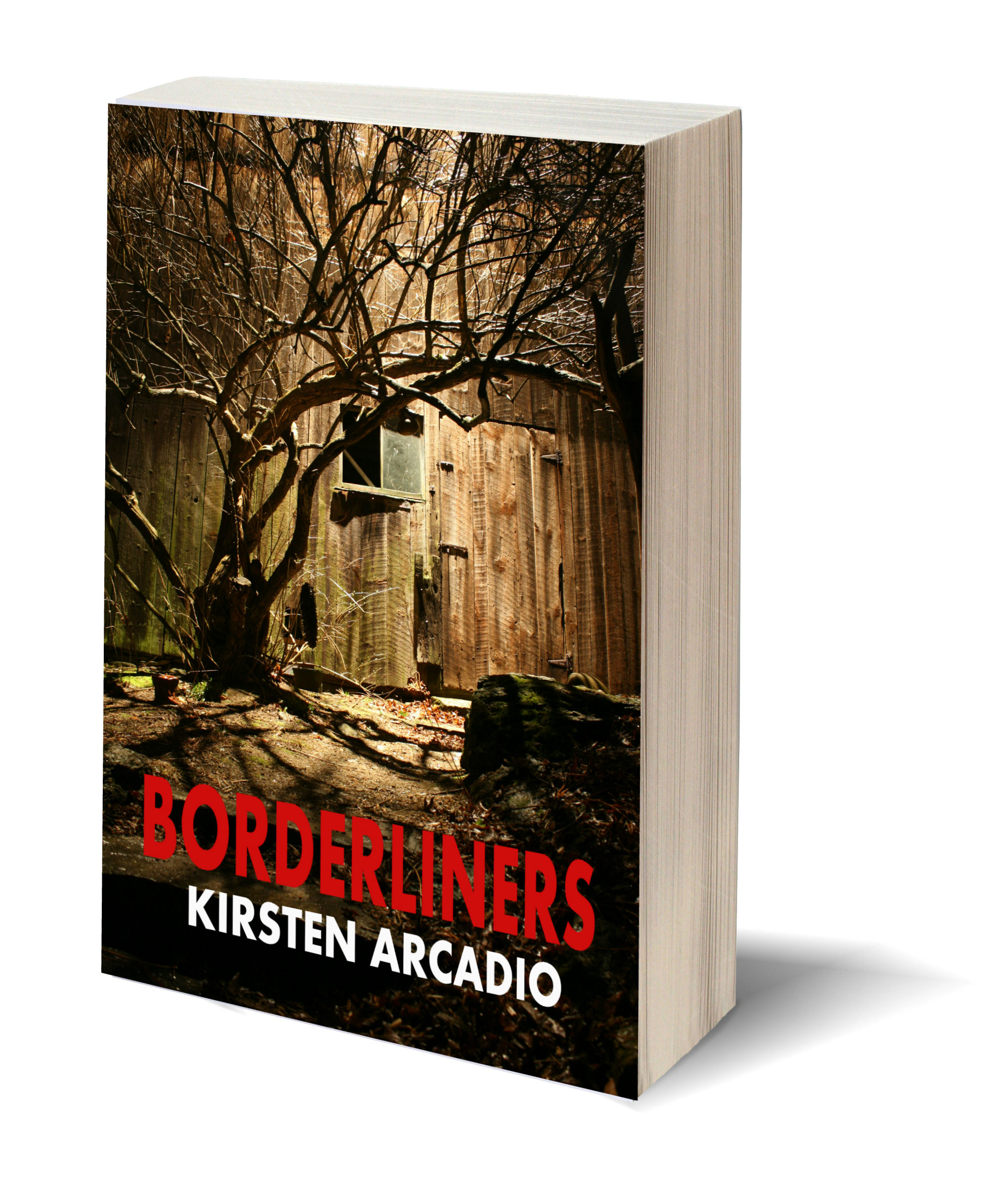
Goodreads Borderliners page screenshot


Why is this?

Well, maybe because Goodreads is all about connections. Rather than having books shoved at them, readers make their own connections with other readers and use their readers’ community to decide what might be a good read for them. Goodreads also has a great categorisation system. I discovered this recently when attempting to place my book in different genres on the site. This is not possible for an author to dictate, which is great.

No, rather like Netflix, the site uses meta data gathered from readers’ reviews, impressions and reviews of a book in order to decide which categories and genres it appears in. In other words, readers rule!

Vive Goodreads!

P.S. If you are interested in my Goodreads Giveaway for Borderliners, it is open until 5 April 2014.

Comments Off on Goodreads

Filed under Uncategorized

Dreams and reality

‘You ever have that feeling where you’re not sure if you’re awake or still dreaming?’

Still one of my favourite quotes from a film in recent years, and now quite iconic, this quote from The Matrix is central to what inspires me in literature.

The fictive dream

On a creative writing course I completed last year with Faber Academy, the term ‘fictive dream’ was discussed. I loved this because this is what writing is to me: dreaming. It’s also many other things, including communicating with readers in a three dimensional way, and finding solutions to questions which preoccupy me life.

Why do I say writing is communicating in 3D? Well, in the words of Milan Kundera, ‘the reader’s imagination completes the writer’s vision.’ And not in an obvious way. I love that readers take their own impressions of the content I’m writing about, their own interpretations and observations, that they see new things I’d never even imagined in what I write, but which are every bit as relevant to the text as what I’d intended. In fact, more so, as stories are meant for others to interpret in a way which is meaningful to them.

As for finding solutions, again I don’t want to be didactic. I am only interested in working through my own thoughts. Often writing a new story throws up answers to old questions. Characters I’ve created supply the answers at unexpected junctures and it amazes me that these answers are somehow coming from my own mind. Sometimes answers only come out after others have read what I’ve written and seen something I hadn’t.

The question

So what are the questions? Another of my favourite quotes from The Matrix goes like this: ‘It’s the question that brought you here. You know the question, just as I did. Neo.’ This is true of novel writing, for me.

The questions which drive me are varied. The blurred line between illusion and reality is one. A big one. It comes up in Borderliners, beginning with Elena’s vision dreams, which seem to point to future events in the real world and ending with another conundrum which looks at the nature of time itself and the difference between our perception of when events happen and other possibilities therein.

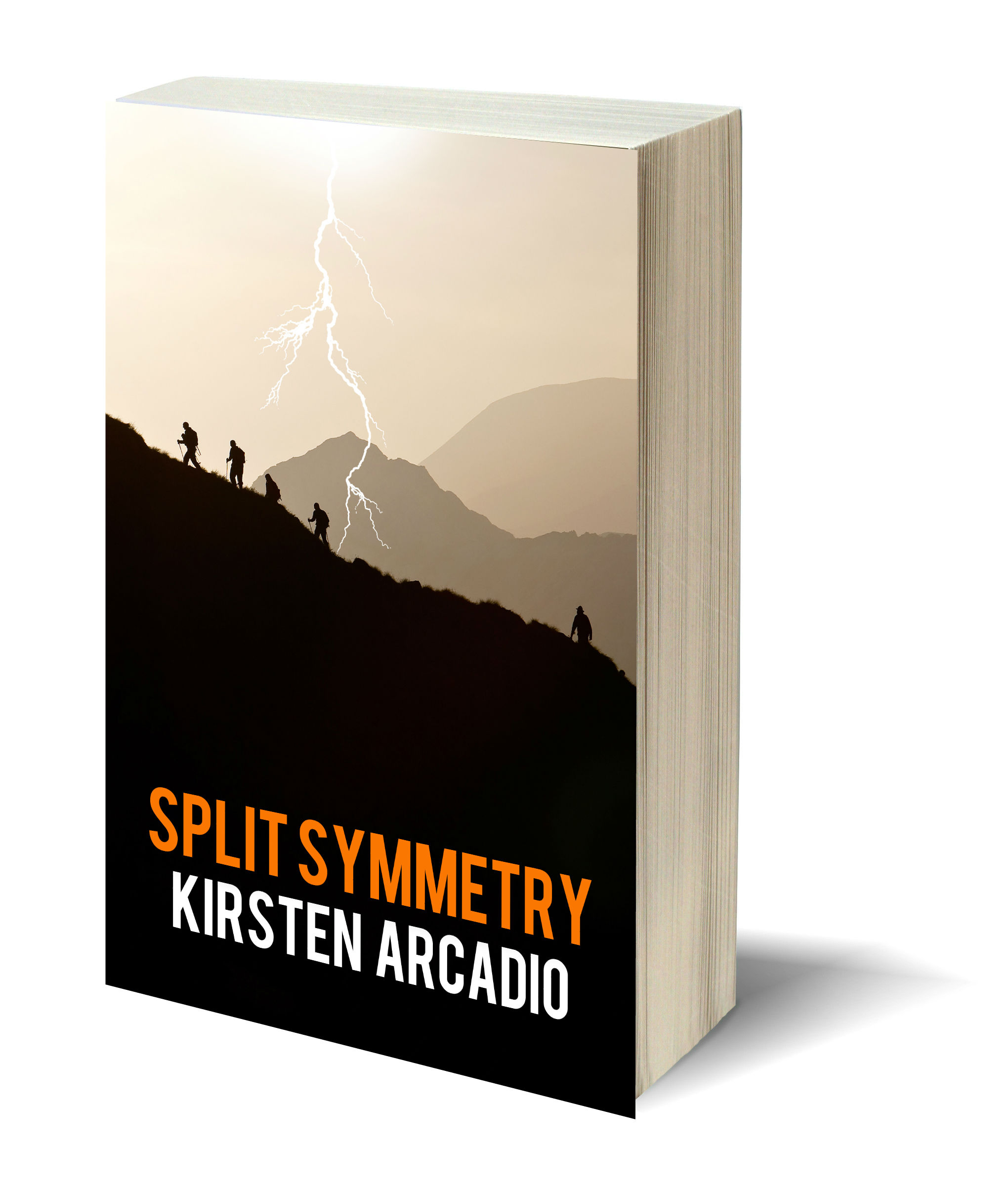
The same idea follows through into my second novel (out later this year), Split Symmetry, which asks: if the possibility of alternate universes posed by quantum mechanics were true, which would be our true reality, and if everything which could happen, does happen somewhere out there, which path is the right one?

Readers, maybe you can help me complete the vision on this one?

Comments Off on Dreams and reality

Filed under Novel writing

Who joins a cult and why

At a recent party a friend and I were discussing the themes in my book, Borderliners. One topic in particular came up, that of handing over one’s advocacy to other people. My friend said she couldn’t understand why people did it but then we both remembered times in our lives when we had, in fact, almost done it ourselves. In my case, I was most susceptible to cult-like groups as a teenager (although never actually recruited). This is not surprising, considering ones teens are a time when many are looking for direction, often not from their parents or the people they grew up around. however, there are other times in a person’s life when they may be vulnerable.

Vulnerable people

Perhaps, more important than age is a person’s vulnerability at any given time. They may be going through life changing experiences, illnesses, death of family members, relationship breakdown or other traumatic incidences.

According to the author of this post on who joins cults and why, there are a few factors researchers have found cult members to have in common:

  • A desire to belong
  • Unassertiveness (the inability to say no or express criticism or doubt)
  • Gullibility (impaired capacity to question critically what one is told, observes, thinks, and so forth)
  • Low tolerance for ambiguity (need for absolute answers, impatience to obtain answers)
  • Cultural disillusionment (alienation, dissatisfaction with the status quo)
  • Idealism
  • Susceptibility to trance-like states (in some cases, perhaps, due to prior hallucinogenic drug experiences)
  • A lack of self-confidence
  • A desire for spiritual meaning
  • Ignorance of how groups can manipulate individuals

No spoilers here, but my book, Borderliners, contains examples of most of the above. I’m interested in human frailty and how it is manipulated, in power and control and why, sometimes, it corrupts. Why is this? And what are the consequences?

Charismatic leaders

In earlier post about charismatic leaders, I looked at what makes a powerful leader. Charismatic leaders aren’t always bad. Look at Martin Luther King, for example. However, lots are…or maybe become so as their power increases. Many people agree Adolf Hitler was a charismatic leader, for example.

Politics isn’t the only arena. At the heart of many religious cults you’ll also find a charismatic leader. Often it is possible to recognise you are dealing with a cult through the assumed importance of one leader who is crucial to the cult’s existence. This is a red flag. (NB. there can be political as well as religious cults, but my novel only deals with the former.)

Warning signs you are dealing with a cult

There are few other red flags, taken from this Wiki about how to avoid cults:

  • The cult may try to attack a person’s existing religious or moral beliefs
  • There may be a dubious past history associated with the cult
  • The cult may threaten their members (physically or psychologically)
  • Often cults operate in relatively isolated areas or in places where there are large proportions of isolated people
  • The cult may try to impose rules on non-moral aspects of life (e.g. where their members go shopping, which books they can read)
  • The cult may approach targets with lots of flattery, at first
  • The cult may say people not in their group will go to hell or come to some other sticky, usually violent end
  • Overall, the cult will want control over a large proportion of their members’ lives.

When I was researching Borderliners I found the sheer number of reported cults overwhelming. It seemed there were far more – everywhere – than I had ever imagined. The question I asked myself was…what does this say about humanity, what does it say about today’s world?

Comments Off on Who joins a cult and why

Filed under Uncategorized

Happy Friday

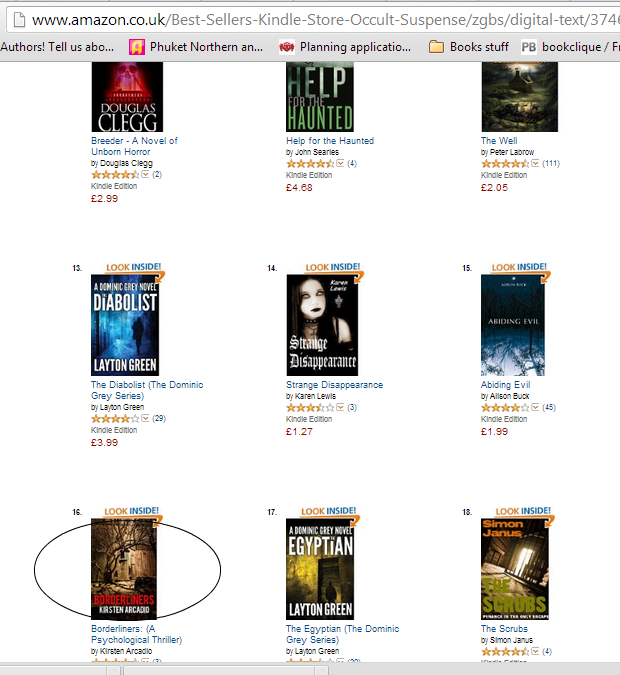
Amazon best seller number 16 Occult SuspenseA great day today, as Borderliners hit an Amazon Bestsellers’ list at number #16.

The list is ‘Occult-Suspense’ and one I had to email Amazon through my KDP dashboard in order to get into. Previously the list I was able to pick from the categories showing in KDP was Horr0r-Occult, which isn’t correct. My book does not have any horror in it.

http://www.amazon.co.uk/Best-Sellers-Kindle-Store-Occult-Suspense/zgbs/digital-text/3746244031/ref=zg_bs_nav_kinc_4_362262031

The idea to email Amazon rather than just accept the categories showing in KDP came from David Gaughran’s excellent book, ‘Let’s  Get Visible: How to Get Noticed and Sell more Books.’


Comments Off on Happy Friday

Filed under Novel writing

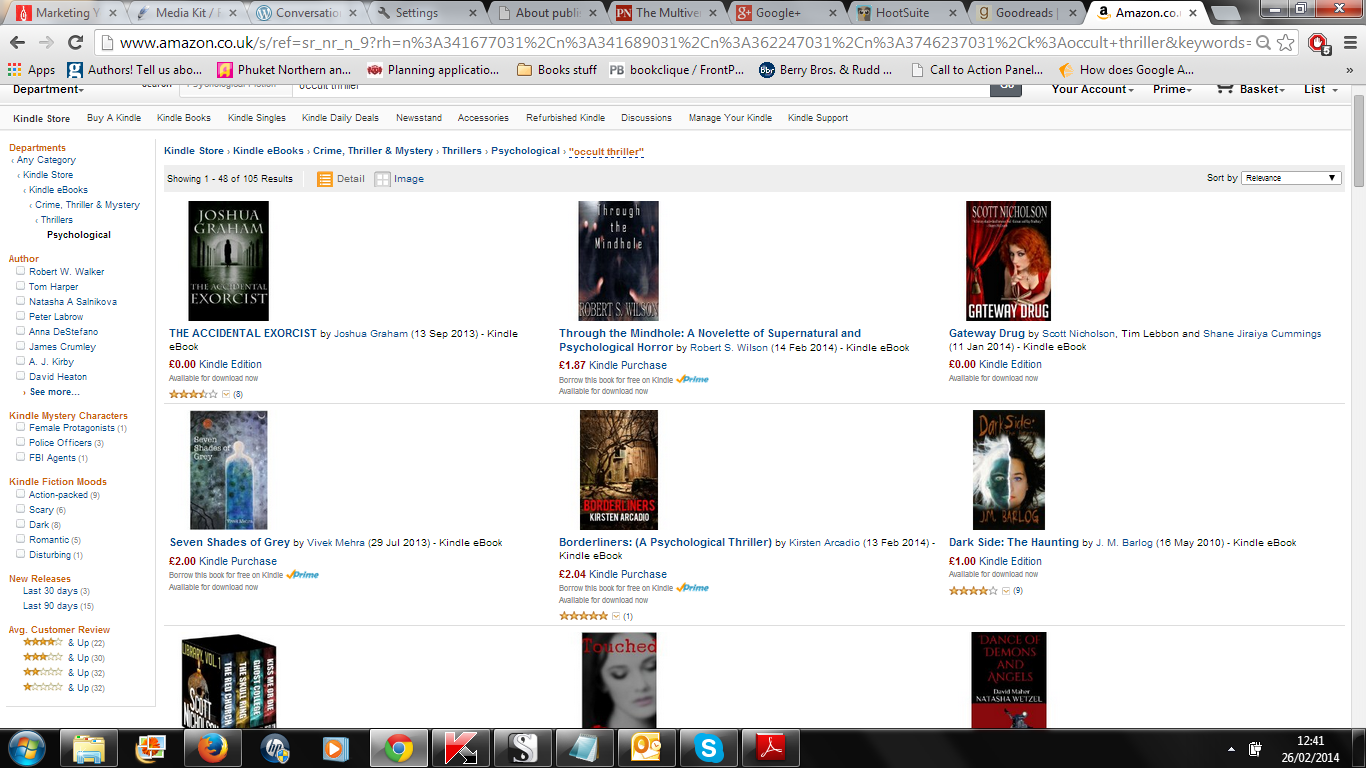
Borderliners makes it to the front screen in Amazon’s psychological category

Borderliners in psychological Amazon category 26 Feb 2014

I’m really excited, as today I managed to get Borderliners ‘visible’ in an Amazon category.

Hoorah! Small but significant steps.

Comments Off on Borderliners makes it to the front screen in Amazon’s psychological category

Filed under Uncategorized